
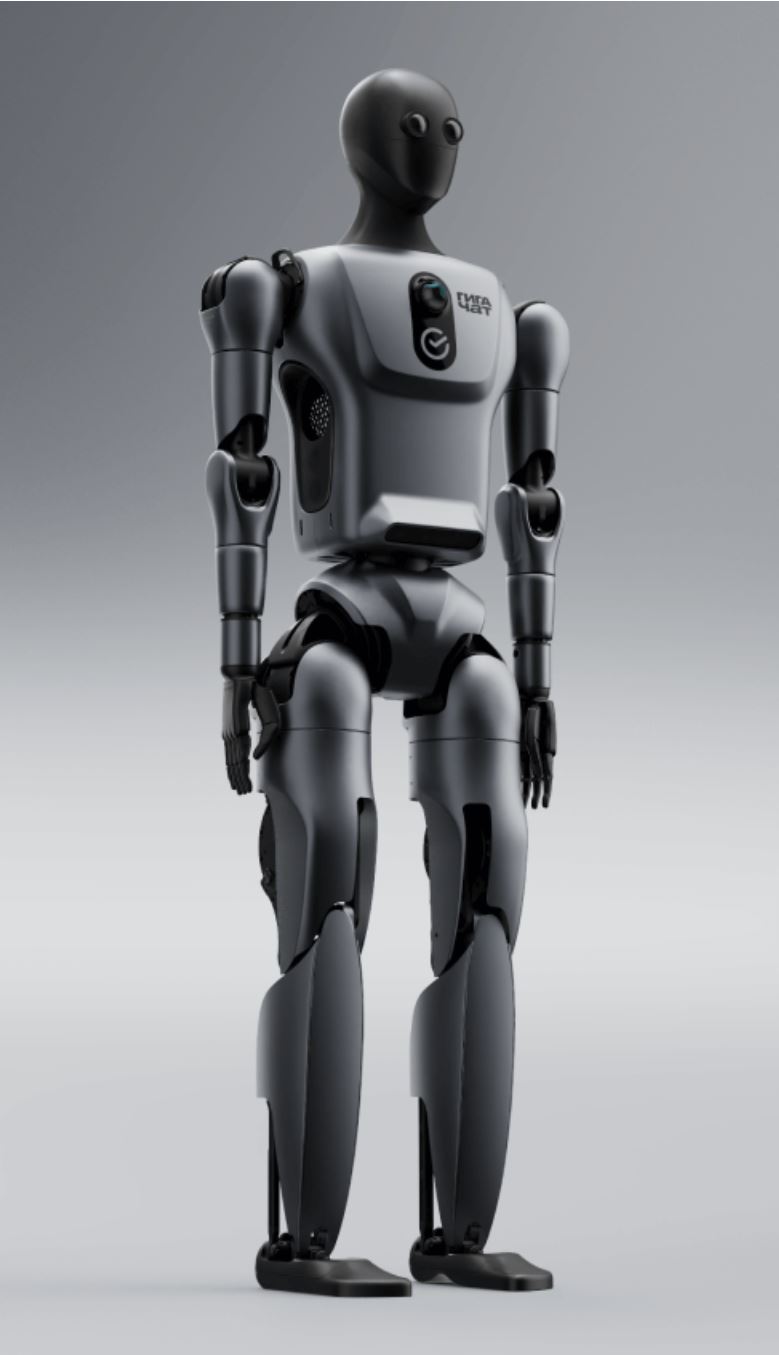
In November 2025, Russian banking and technology giant Sber unveiled Grin — its first in-house anthropomorphic robot — at the AI Journey conference in Moscow. The robot runs on Sber’s GigaChat neural network and is designed to perform physical tasks in real-world environments.
Grin is equipped with over 40 motors and a sensor suite that includes ten visual sensors, inertial measurement units, and force sensors for balance and movement precision. Voice interaction is handled through GigaChat, allowing the robot to understand spoken commands and hold conversations. At AI Journey 2025, Grin operated continuously for over ten hours, completing tasks without noticeable degradation or failures.
In February 2026, Sber published Green-VLA — an open-source Vision-Language-Action model that unifies visual perception, language understanding, and physical action into a single robot control architecture. The model achieved state-of-the-art results on international benchmarks including Simpler Fractal and Simpler widowX (Stanford / Google) and CALVIN (University of Freiburg), gained recognition on Hugging Face, and won a competition in China.
At the CIPR-2026 conference in Nizhny Novgorod, Sber’s Senior Vice President Andrey Belevtsev called physical AI “the key technology of the 21st century for Russian industry.” He noted that Grin remains a research project for now but is expected to become a commercial product. Sber CEO Herman Gref has stated that with each new version of GigaChat, the robot will expand its capabilities across retail, manufacturing, and food service.
Photo: sber.ru