
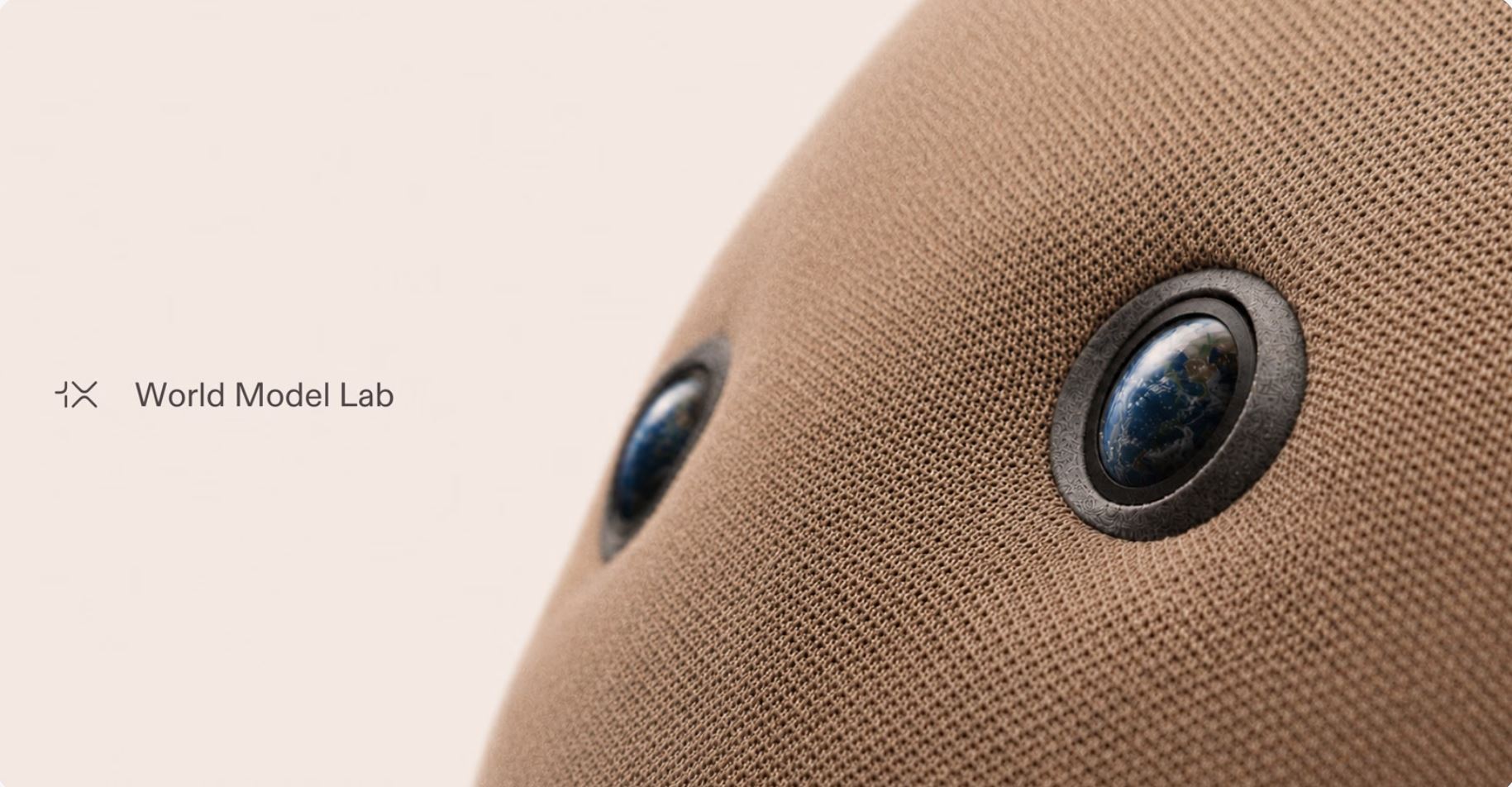
Image: 1X.tech
We just covered how China is building a network of training grounds for humanoid robots to be first to mine the “training ore” of embodied AI. Today, the mirror image from the Western side: Norwegian-American 1X Technologies has announced the launch of the 1X World Model Lab — a new research organization dedicated to large-scale pretraining of “world models” for humanoid robots. Different strategy. Same race.
What was announced
On June 4, 1X Technologies — the maker of the NEO humanoid robot — announced the formation of the 1X World Model Lab, a frontier research organization focused on a single task: accelerating the path to fully autonomous humanoids through large-scale world model pretraining.
The lab will be led by Sam Sinha as Founding AI Researcher and Head of World Models. Sinha previously worked as a research scientist at Luma AI, one of the leading companies in generative video, where he contributed to work on models including Uni-1.
The launch comes immediately after 1X reported breakthroughs with its in-house world model: the NEO robot, by the company’s account, is now capable of performing entirely new tasks without prior training — what the industry calls zero-shot execution.
The core thesis: “robotics is not a fine-tuning problem”
In its announcement, 1X frames a position that sounds almost provocative for the industry:
“Robotics is not a fine-tuning problem. To build truly general humanoids, we need to pretrain on the most important data from the very beginning.”
In plain English: most companies today take off-the-shelf foundation models (pretrained on internet data) and fine-tune them for a robot. 1X says that path is a dead end. Embodied intelligence requires that the model “sees” the physical world from the very start of its training — not as an after-the-fact adjustment.
What that means in practice: 1X plans to train its foundation models from scratch on a mix of:
— web-scale media (open internet video);
— ego-centric human video, recorded by people performing everyday and workplace tasks;
— simulation data;
— data collected by NEO robots under remote operation (with a human at the controls);
— and so-called on-policy data — data that NEO collects autonomously, while operating under its own current policy.
“The only durable moat is data”
Right there is the strategic thesis of the lab:
“The only durable moat in embodied AI will be data: the ability to collect, annotate, scale, and train on the right mixture of web-scale, human, simulated, remote operator-generated robot data, and robot-generated data.”
The word “moat” is venture-speak shorthand for a competitive advantage that can’t be quickly copied. And 1X says it directly: in embodied AI, the only such moat is data. Not the algorithm. Not the model. The data.
This is the same thesis we just unpacked in our piece on China’s network of humanoid training grounds — there it was framed as the “training ore” for robots, which doesn’t exist in pre-collected form and has to be mined.
Same race, different strategy
And here’s the real pivot. If the thesis is the same on both sides, why are the strategies so different?
China is building a network of physical training grounds across multiple cities (Shanghai, Beijing, Zhengzhou). Hundreds of machines from dozens of manufacturers train at them simultaneously. The principle is centralized data accumulation through shared training infrastructure, with manufacturers pooling results.
1X moves in the opposite direction: a vertically integrated company that controls the entire stack — from its own humanoid NEO, to its own factory (NEO Factory in California is already live), to, now, its own AI lab. The principle is a closed loop, in which a single company collects data from its own fleet of machines operating in the real world.
1X’s CEO Bernt Børnich puts it bluntly:
“To reach full autonomy fastest, you must own the entire stack — down to pretraining your own video foundation models. That’s why we built the 1X World Model Lab.”
Two approaches — a public “common school” versus a closed “vertical stack.” Both converge on the same thesis: data.
What this means for the industry
A few articles ago we covered the Hong Kong Embodied AI Lab and its 24 partners. Before that, AGIBOT and its AGILE model, which requires enormous volumes of motion data. Then, China’s network of training grounds. Now, the 1X World Model Lab.
When four independent sources — a Norwegian-American private company, Chinese state-run centers, a Hong Kong university, and the largest Chinese humanoid maker — arrive at the same conclusion from different directions, it stops being a series of separate news items. It becomes the formation of a consensus on where the real race actually is.
And that race is for data. Whoever collects the right mixture first — web video + ego-centric video + simulation + teleoperation + autonomous operation, and at the right scale — gains an advantage that will be very hard to close.
Sam Sinha frames it in his own quote, with an almost fierce undertone:
“Embodied data has been treated as a second-class citizen for too long. Embodied AI is too important to be a fine-tuning problem.”
That is the line 1X plans to live by going forward.
Based on the official announcement by 1X Technologies, June 4, 2026.