
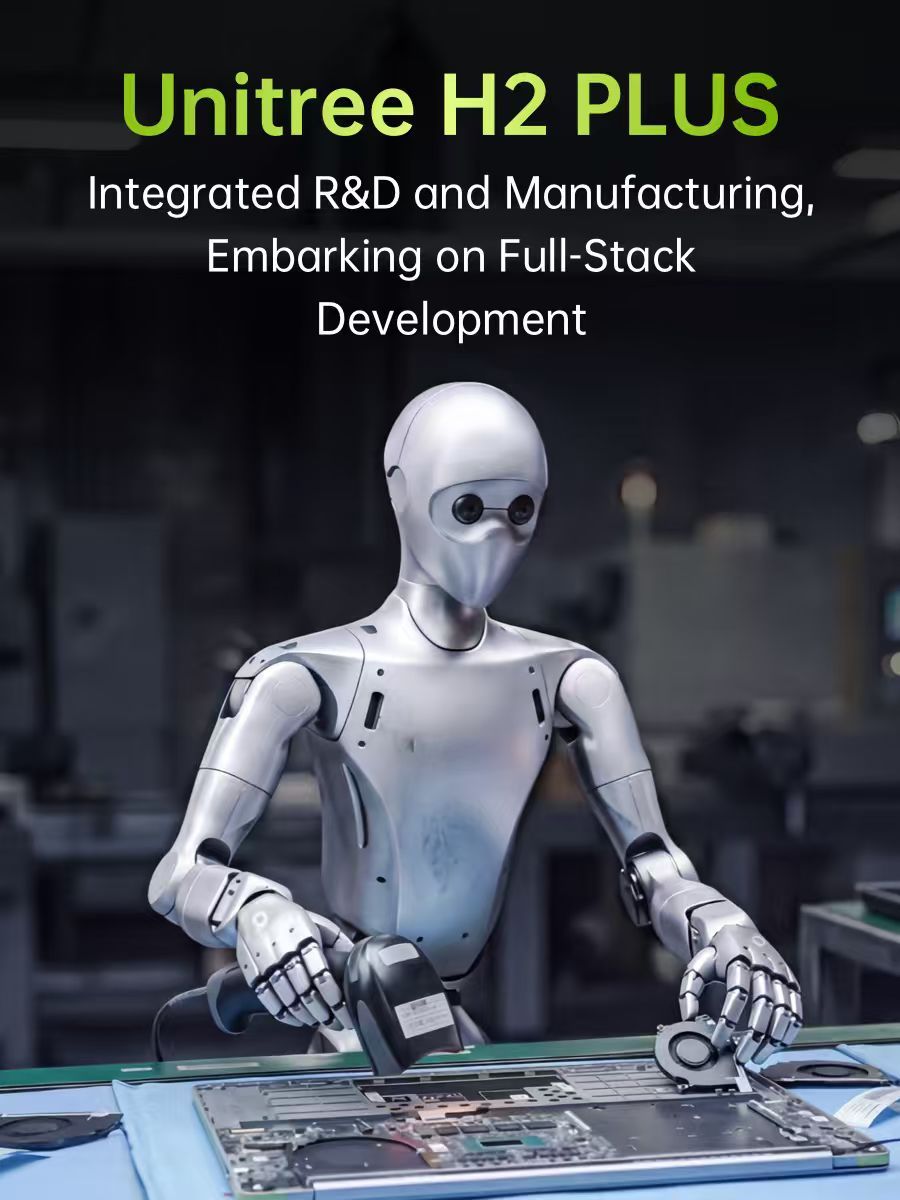
In early June, NVIDIA and Unitree unveiled the Unitree H2 Plus — the first open reference design for a full-size humanoid robot. In plain terms, it’s a ready-made kit: Unitree supplies the body (the 1.8-meter H2 platform), the company Sharpa supplies five-fingered tactile hands, NVIDIA supplies the onboard computer (Jetson Thor), and the “brain” and all the software come from NVIDIA’s open Isaac GR00T platform. They assembled it, validated it, and offered it to any research lab as a single starting point. The first to take it: Ai2, ETH Zürich, the Stanford Robotics Center, and UC San Diego.
You could frame this as “another robot launched.” But the more interesting thing isn’t the robot — it’s the move behind it, one I’ve been seeing more and more lately.
The race isn’t for the robot — it’s for the position
Notice where NVIDIA is putting its effort. Not into building “the world’s best humanoid” — it doesn’t even make a robot of its own. It’s into becoming the platform every other player builds their robots on. You can get the body from Unitree, the hands from Sharpa — but the computation runs on NVIDIA’s chips, and training, simulation, and deployment go through its Isaac GR00T software. NVIDIA isn’t taking the seat of robot maker; it’s taking the seat at the center of the whole thing.
A telling detail: NVIDIA’s own research division will use the H2 Plus as its internal reference system. So academic labs and NVIDIA itself run on the same stack. Or, as commentators put it more sharply: NVIDIA takes the hardware-and-software stack that used to be locked inside Figure, 1X, and Tesla, and ships a validated version to anyone with a purchase order. Exclusive becomes standard.
This isn’t a one-off — it’s a pattern
And here’s what makes it genuinely interesting: NVIDIA isn’t alone. Several big players are making the same move, just at different layers.
AGIBOT gives away an open dataset of real robot interactions — bidding to become the hub of data. NVIDIA, through Cosmos, gives away open models for generating synthetic data — the hub of simulation. And now, through Isaac GR00T, it gives away an open development stack — the hub of software. The logic is the same for all of them: hand out something valuable for free, in order to become the infrastructure no one else can do without.
There’s a precise historical precedent — ImageNet, the free, open database of labeled images. It once moved the entire field of image recognition and became the foundation everyone depended on. Whoever hands out the foundation gets to set the rules on the floor above.
Where’s the catch
“Open” sounds like “free and ownerless,” but it isn’t quite — and the distinction matters.
First, what’s open is the software, not the robot. The H2 Plus itself is a paid Unitree product, shipping toward the end of 2026. The stack is free; the hardware isn’t.
Second, that open stack runs on NVIDIA’s chips and computers. So open software quietly ties you to its compute — exactly the same mechanism as Cosmos: the model is free, but you run it on their hardware.
Third, standard-setting is dependency. When the whole academic world learns and validates robots on one stack, that stack becomes the de facto standard, and its owner becomes the point you can’t route around. Generosity here is a way to take a position, not to give one up.
The political backdrop
NVIDIA, an American company, partnering with China’s Unitree plays out against a curious backdrop. In May, Jensen Huang flew to Beijing as part of Trump’s delegation, and Washington began easing chip exports to China. There’s probably no direct link to the H2 Plus — a product this big takes months, not the two weeks since the summit. But the very fact that an American chip giant is building its flagship reference robot on a Chinese “body,” at a moment of US–China thaw, shows how tangled these supply chains are — trade wars and all.
What it means
Look only at the robot, and the H2 Plus is “a convenient kit for labs.” Look at the strategy, and it’s another brick in the wall the giants are building around themselves. The humanoid race is less and less about whose robot walks better, and more and more about whose stack, whose data, and whose chips everyone else builds on. And giving away the open part is the most effective way to end up at that center. You pay now with a free stack — and collect the whole ecosystem later.
Based on NVIDIA and Unitree press releases (May 31 – June 1, 2026, GTC Taipei / ICRA), and reporting by The Robot Report, Engineering.com, and GamesBeat.