
Image: humanoidssummit.com
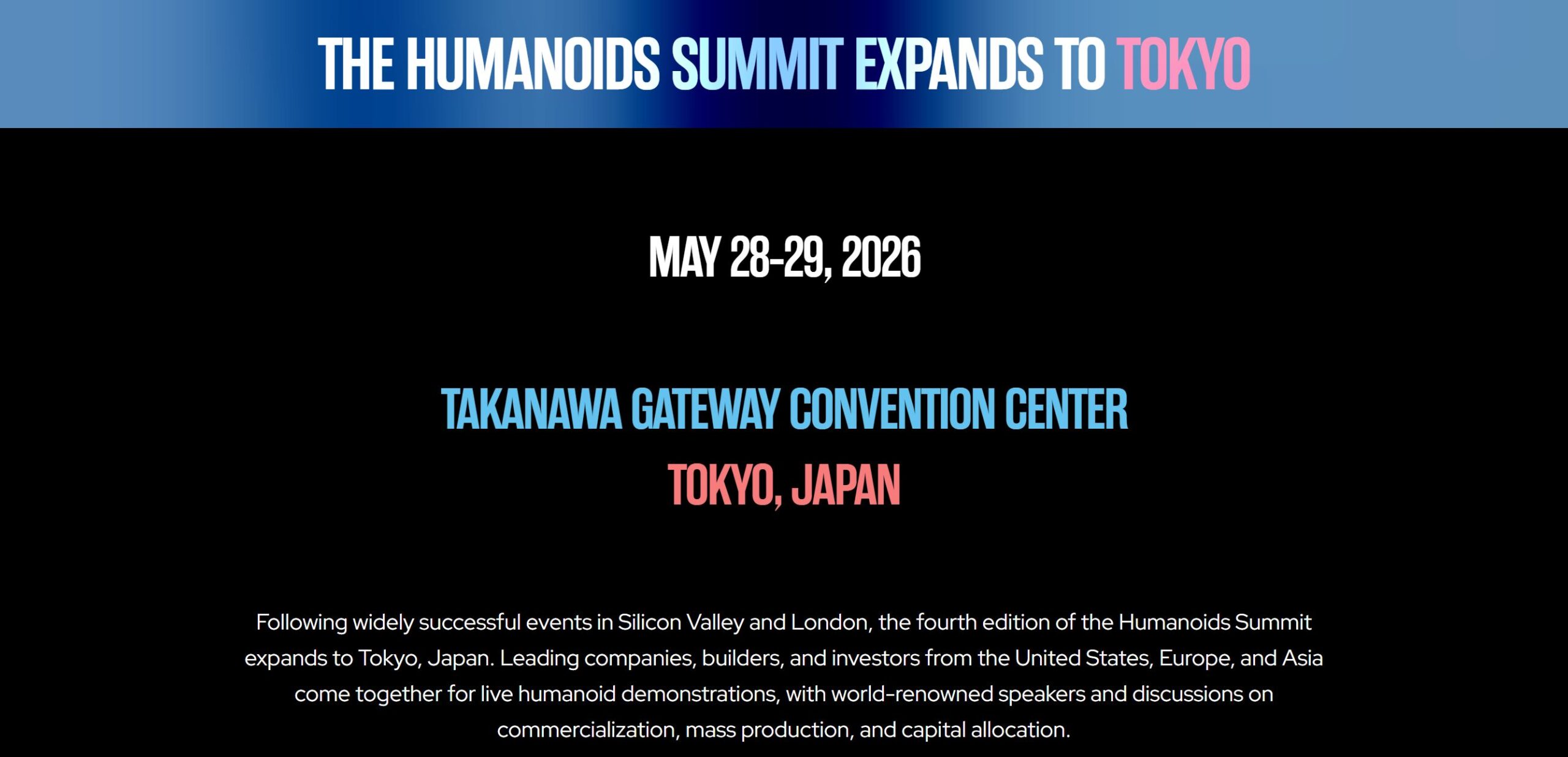
Humanoids Summit Tokyo 2026 takes place May 28–29 at the Takanawa Convention Center in Tokyo — the fourth edition of the series and the first held in Japan. The opening keynote will be delivered by Professor Hiroshi Ishiguro, director of the Intelligent Robotics and Communication Laboratories at ATR (Osaka University), known for his work on lifelike androids in the Geminoid series. Other speakers include Carolina Parada (Google DeepMind), James Wells (Sanctuary AI), Moritz Baecher (Disney Research), Brendan Schulman (Boston Dynamics), and representatives from Toyota, Honda, Unitree, and dozens of other companies.
The summit takes place against an unprecedented commercial expansion across the industry. In March 2026, Chinese manufacturer AGIBOT announced its 10,000th humanoid shipment, having scaled from 5,000 to 10,000 units in three months. According to Omdia and IDC analysts, AGIBOT ranked first in global humanoid robot shipments in 2025. In parallel, U.S. companies Apptronik, Figure, and Tesla, and Chinese companies Unitree, XPENG, and UBTech have moved humanoids from laboratories into production. In March 2025, NVIDIA unveiled Isaac GR00T N1 — the first open foundation model for humanoid robots — after which similar models began appearing from platform manufacturers themselves. A global summit of this scale is being held in Tokyo for the first time — a country historically tied to the origins of modern humanoid robotics.
Programme and speakers
The summit lineup spans several layers of the industry. Among platform manufacturers — Apptronik with Apollo, currently being piloted on Mercedes-Benz lines; Sanctuary AI with the Phoenix humanoid; Boston Dynamics with the electric Atlas; Mentee Robotics; and Chinese players Unitree, ROBOTERA (whose talk focuses on five-fingered hands), Booster Robotics, and High Torque Robotics.
On the research and foundation models side — Google DeepMind (Carolina Parada opens Day 2 with “From Language to Motion: How Gemini Powers the Next Generation of Robots”), Disney Research with a presentation on its robotic character platform, FieldAI (industrial AI), and Archetype AI.
On the components and manipulation technology side — PSYONIC, a developer of bionic hands; UltraSense Systems (ultrasound tactile sensing for hands); RLWRLD (five-fingered dexterity); Renesas and Infineon (semiconductors for humanoids); Contact CI (teleoperation haptics).
From Japanese industry and government: Tomohiro Nomi, head of Toyota’s Humanoid Robotics Research Unit; Takahide Yoshiike of Honda R&D Frontier Robotics, presenting Honda’s new multi-fingered hand; a representative from METI (Ministry of Economy, Trade and Industry) — Deputy Director-General of the Commerce and Information Policy Bureau; the chairman of AIRoA (AI Robot Association of Japan); and GMO AI & Robotics with “Year One of Humanoids — Japan’s Deployment Frontline.”
The full agenda is available at humanoidssummit.com/agenda-2.
Manipulation as the dominant theme
A through-line across both days is manipulation and hand sensing. At least six presentations focus on five-fingered dexterity, tactile interfaces, or new hand designs. This is not coincidental: locomotion — walking, running, balancing — was largely solved in the research phase and refined by industrial models over the last three years. Manipulation, particularly with soft, flexible, slippery, or geometrically unpredictable objects, continues to separate impressive demos from practical deployment.
A notable talk in this cluster is PSYONIC founder Aadeel Akhtar’s presentation on May 29, titled “Advanced Bionic Hands for Humans and Robots.” PSYONIC came from the medical field: development of the Ability Hand, a prosthetic with multi-jointed digits and tactile feedback, originally for users with limb differences. Over the past two years this technology has been integrated into several humanoid platforms — a practical manipulation solution informed by years of real-world consumer use.
In the same cluster: the announcement of Honda’s new multi-fingered hand. Following the discontinuation of active ASIMO development in 2018, Honda has not publicly taken a humanoid robotics step of comparable scale. The presentation by Takahide Yoshiike, Executive Chief Engineer at Honda R&D Frontier Robotics, is one of the strongest industrial signals of the summit.
China at the summit: who’s there, who isn’t
Among major Chinese humanoid manufacturers, Unitree is on the programme — a company leading shipment volumes for research and consumer models (G1, H1, R1). Also represented: ROBOTERA, Booster Robotics, High Torque Robotics, and Lightwheel.
Notable absences from the programme: AGIBOT (the current shipment leader), XPENG Robotics, and UBTech. This partly reflects the summit’s organising profile — it is produced by ALM Ventures, based in Silicon Valley, and an American orientation shows in speaker selection.
The industry moves in parallel through two main ecosystems — the U.S. and China — but points of intersection exist, and Humanoids Summit Tokyo 2026 is one of them.
Japan’s return
Japan occupies a particular place in humanoid robotics. The modern segment in many ways began here: Honda’s ASIMO, unveiled in 2000, was the international benchmark for bipedal locomotion for more than a decade. Kawada’s HRP series — HRP-2 (2004), HRP-4 (2010), HRP-5P (2018) — remained the academic standard for research laboratories worldwide. NAO and Pepper, developed by French company Aldebaran Robotics — acquired by Japan’s SoftBank in 2015 — defined the social humanoid format.
Over the past five years, the Japanese segment has been commercially quiet. Honda discontinued active ASIMO development in 2018. Pepper was discontinued in 2021. Toyota and Honda continued research, but without commercial models comparable to American Figure 02, Apptronik Apollo, Tesla Optimus or Chinese newcomers Unitree G1, AGIBOT A2, XPENG Iron.
The Japanese lineup in Tokyo suggests this pause may be ending. The announcement of Honda’s new multi-fingered hand, the Toyota Humanoid Research Unit presentation, METI’s stance on national robotics policy, AIRoA’s participation — these constitute a public claim by one of the world’s leading industrial economies to re-enter active commercial competition. Whether that claim materialises in products over the next 12–18 months is a separate question. But the summit’s positioning — where Japan participates as a peer to American counterparts rather than merely hosting — is already a shift.
What to watch
The summit’s key open questions:
— Will Japanese companies (Toyota, Honda, Kawada) announce concrete timelines for commercial humanoid products? — This would be the most significant industry signal.
— What partnerships between Western platform developers and Japanese industrial companies will be announced? — Japan’s manufacturing base could become one of the venues where humanoids are tested and deployed at scale.
— What will Google DeepMind show on Gemini for robotics? — Potentially an announcement of a new version or performance benchmark.
— What position on industry regulation will American and Japanese speakers articulate? — Regulation is becoming one of the main indirect competitive themes in the field.