
Based on the official Yandex Robotics website and publications in Forbes, Kommersant, CNews, and ComNews.
I write a lot on this blog about the major global players in robotics — China’s AGIBOT, the Norwegian-American 1X, Hong Kong’s robotics labs, Shanghai’s training grounds for humanoids. Today, a piece about a Russian player. Yandex Robotics is the Yandex division building mobile robots and software for warehouse logistics. On the global scale, Yandex Robotics is a narrow-focus player — but in its segment, it offers the most mature solution available in the Russian market, and one already operating at major external clients.
What does Yandex Robotics do?
Yandex Robotics is a Russian company focused on warehouse automation. Legally, it has existed since September 2024: that’s when the Yandex Market Robotics Center — an internal division that had already been running for about three years — was spun out into a standalone legal entity. The company is based in Moscow, runs two R&D centers in Russia, and has a team of more than 180 employees.
Yandex also has a second direction in robotics — the delivery robots, or “rovers,” which are now in serial production. That’s a separate product with its own team and strategy; it’s not covered in this article, and I’ll do a dedicated piece on the rovers later.
Yandex Robotics builds three classes of things.
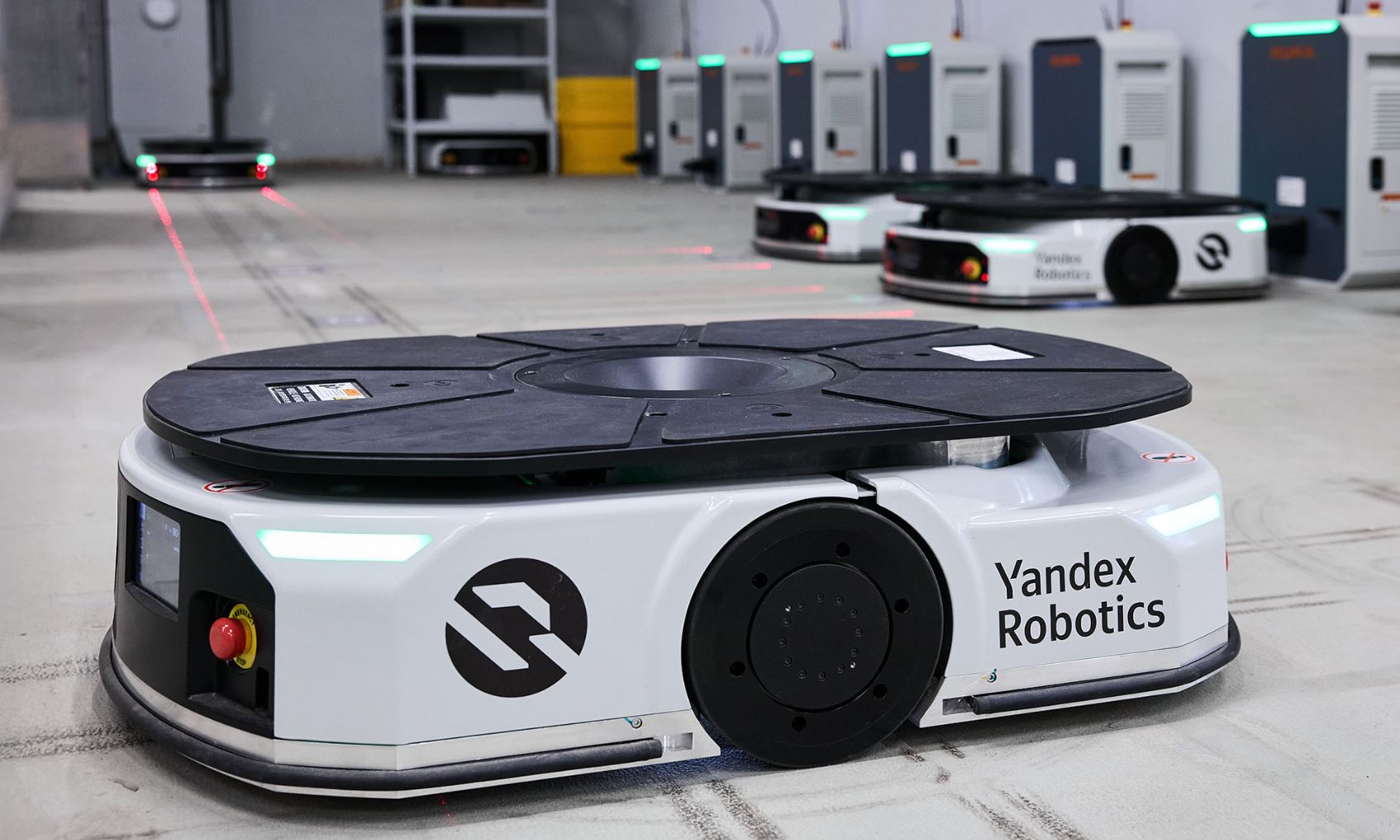
- Mobile robots of two types: AMR (Autonomous Mobile Robot), platforms that move pallets between zones of a warehouse, and FMR (Forklift Mobile Robot), forklift-style robots that lift and place loads.
- The Yandex RMS software platform (Robot Management System) — a “dispatcher” for a robot fleet: it integrates with the client’s warehouse management system (WMS), receives picking tasks from it, and turns them into routes for each individual robot. Important detail: Yandex RMS is built to coordinate robots from different manufacturers, not only Yandex Robotics’ own. CNews described it as “an industrial smart-home for the warehouse.”
- Ready “boxed” solutions for specific operations: depalletization, inventory checks, goods-to-person systems, picking for order assembly, put-wall sortation, and stacking of cardboard boxes and bags.
The business model is hybrid: classic outright sales plus subscription (RaaS, robots-as-a-service), launched in July 2025. The first external subscription client is the supermarket chain Azbuka Vkusa: a Yandex Robotics inventory robot operates at its Moscow warehouse under that model. According to the company, it’s in RaaS negotiations with five additional major clients across different sectors.
Where does Yandex Robotics stand in the global picture?
Warehouse robotics is a large, mature segment of the global market. Every major economy has its national champion: Norway has AutoStore (one of the world leaders by installed base); China has Geek+ (the world’s largest AMR supplier) and Hai Robotics (a leader in case-handling/ASRS systems); the US has Symbotic and Locus Robotics; Germany has KION/Dematic; France has Exotec; Japan has Daifuku.
Yandex Robotics is the Russian counterpart in that lineup. Not a world leader by volume, but the only player of this scale and maturity on the Russian market: with in-house R&D, an in-house software platform, and real-world deployments in production.
An important difference from global players: Yandex Robotics didn’t grow up as a startup looking for a market, but rather from real internal demand at Yandex — the warehouses of Market and Lavka. Unlike young companies that have to find clients and test environments from scratch, Yandex Robotics had three years of running its solutions in its own high-load warehouses even before being spun out. By the time the product reached the external market, it had already gone through thousands of hours of real-world operation.
Flagship case: Perekrestok
The company’s most prominent external contract is the project with the supermarket chain Perekrestok, announced in September 2025. A fleet of 109 robots from Yandex Robotics is being deployed at the retailer’s distribution center in St. Petersburg. Experts polled by Forbes estimated the investment at over 300 million rubles.
A notable detail: Perekrestok selected Yandex Robotics through an open competitive procedure — meaning the deal went through as a full B2B tender. Yandex Robotics was already working with Perekrestok before this, on another site in Sofyino (Moscow region), where an inventory robot of the same design is already in operation. The St. Petersburg contract is a scale-up of existing cooperation.
Numbers reported by Yandex in its press release:
— robots will take on up to 90% of picking tasks in the fresh zone for chilled and perishable goods (about half of all operations at the distribution center);
— order picking will be 2.5× faster: from 130 boxes per hour for a human picker to 300 boxes per hour with robots;
— the distribution center will be able to serve 30 more stores without expanding its physical footprint.
The project is scheduled to be completed by mid-2026.
Mechanically, it works like this: Perekrestok’s WMS sends an order-picking task to Yandex RMS; RMS turns it into specific routes for each robot — where to go, how long to spend at the picking station, where to move next. AMRs move pallets between storage zones and picking points; FMRs collect assembled pallets and move them to the shipping buffer zone.
Yandex Robotics’ partner here — the X5 holding (which includes Perekrestok) — has publicly stated that by 2028, robotics and AI will partially replace up to 30% of operations across its stores, dark stores, distribution centers, and delivery services. In other words, Perekrestok is not a one-off experiment but the first step in a systemic digital transformation of Russia’s largest grocery retailer.
Strategy: internal proving ground → external market
Strategically, Yandex Robotics follows the classic playbook of mature industry players: use Yandex’s own operations as a proving ground for solutions, then scale them out to external clients.
In August 2025, the first automated “robo-dark-store” of Yandex Lavka was launched. Robots handle about 40% of the assortment there — non-perishable goods and snacks; humans continue to pick chilled and frozen products. By mid-2026, five more such automated dark stores are planned for Moscow and St. Petersburg — that is, “dark” delivery distribution centers designed around robots from the ground up.
In parallel, the external client base is expanding. Perekrestok is the flagship; Azbuka Vkusa is the first subscription client; RaaS talks are underway with five more companies. Yandex Robotics positions itself as a supplier to any retailers or logistics companies operating high-throughput warehouses.
The bottom line
On the global picture, Yandex Robotics is a narrow-focus corporate-segment player — not claiming the “stardom” of AGIBOT or 1X. But in its segment — warehouse robotics for the Russian market — this is the most mature solution available today, with real deployments, an in-house software stack, and the R&D economics of being inside the Yandex group.
What’s distinctive about this player is that it’s simultaneously a supplier and a major user. The warehouses of Yandex Market and Lavka serve as a “training ground,” where solutions get battle-tested before being offered to external clients. This is exactly the kind of data flywheel I recently wrote about in pieces on China’s humanoid training grounds and on 1X World Model Lab — except here it works not on humanoids, but on warehouse robots.
Photo: robotics.yandex.ru