
Based on the research paper MotionDisco: Motion Discovery for Extreme Humanoid Loco-Manipulation dated June 4, 2026.
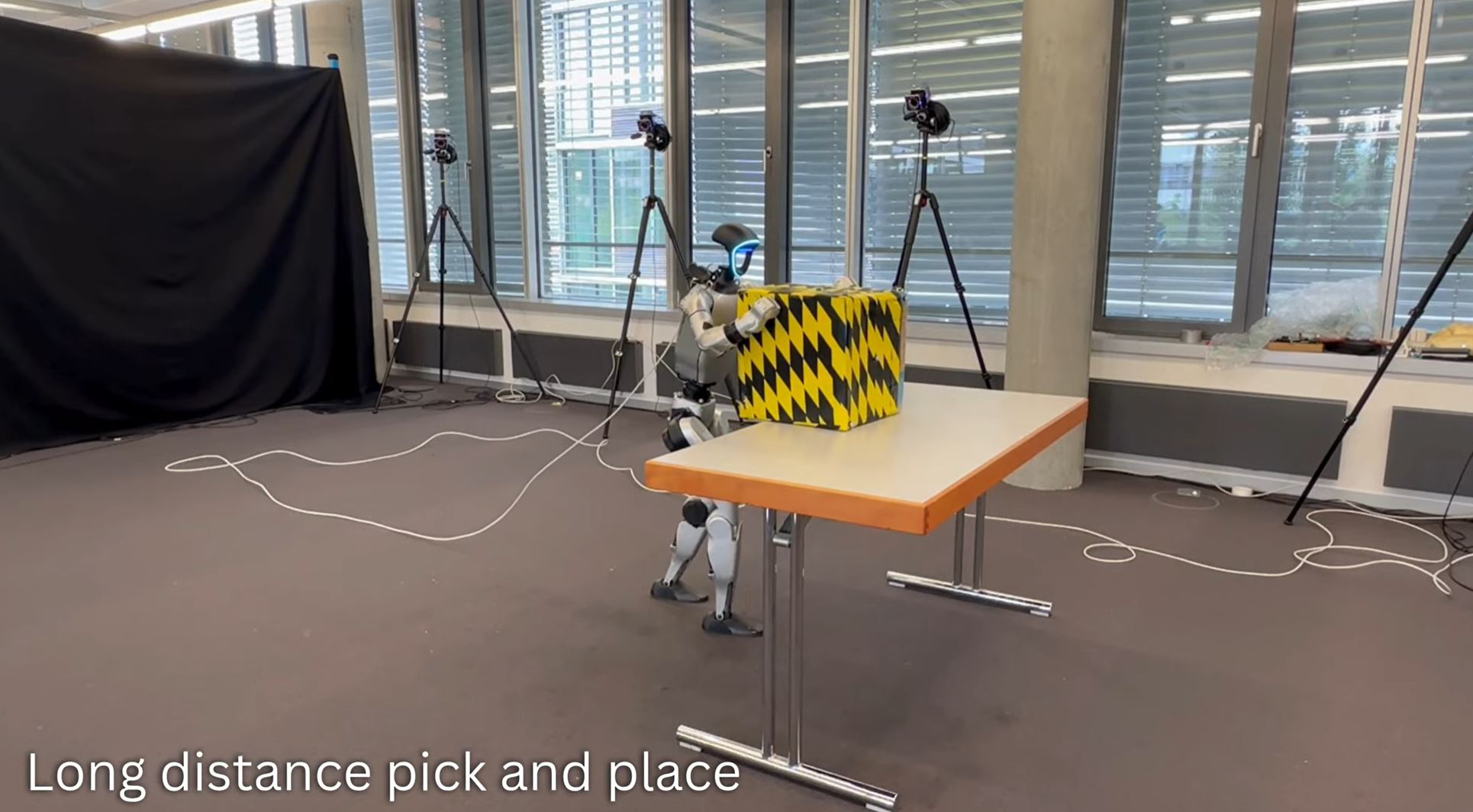
If you have two minutes, watch the video accompanying the paper. In it, a humanoid robot climbs onto a table holding a box, walks across it, climbs onto another table, and sets the box down. In another clip, it bends its whole body to retrieve an object from under a table. In a third, it pushes boxes out of its way to get through. Nothing science-fiction about it: a real robot in a real lab at the Technical University of Munich. But the interesting part isn’t what the robot does — it’s how it was taught to do it.
How humanoids are usually taught?
To understand what’s new in this work, you first need to understand how the industry today teaches a robot new movements. There are essentially two ways.
Method one — teleoperation. A human puts on a helmet, gloves, or a sensor-equipped suit and controls the robot “from the inside” in real time. The robot then memorizes which commands were sent to which motors, and can later reproduce the same movement on its own. This is how most demos by US humanoid startups like Figure or 1X actually work. I’ve written about this problem in detail in the Agility Robotics piece — there, the team itself bluntly called many viral humanoid clips “deceptively disguised theater,” meaning a teleoperator off-camera.
Method two — motion retargeting. A human’s movements are recorded (for example, in a motion-capture studio of the kind used for films), and then mathematically “transferred” onto the robot’s body. Humans and robots have different joint counts and proportions, so the work is complex — but it can be done.
Both methods share one core problem: the robot can only do what a human is able to demonstrate to it. Every new task means new demonstrations. Want the robot to climb under a table? You need a person to show it how. Want it to stack boxes? Same thing. This doesn’t scale — which is, in essence, the ceiling of the entire humanoid industry right now.
A third path: the robot finds the movements itself
This is where MotionDisco — the name of the system described in the Munich team’s paper — comes in. The robot discovers the movements itself, with no human teacher. No teleoperation, no recorded motions. Just a task description: “pick up this box and place it on that table.”
This is where it gets interesting.
At the heart of the system is a large language model (LLM) — the same technology behind ChatGPT and similar systems. Only in MotionDisco, instead of writing text, it writes code describing sequences of contact: in Python, it describes how exactly the robot should interact with the world. For example: “at step 0 both feet are on the floor; at step 1 the left hand grasps the box on the left side; at step 2 the right hand grasps it on the right; at step 3 the box is lifted; at step 4 the right foot steps onto the table…” — and so on.
This code is executed. The resulting motion plan is run through a mathematical optimizer that checks whether such a sequence of contacts is physically possible — whether the robot will bump into the table, whether both feet will leave the floor simultaneously, whether a joint will twist beyond its limit.
If something doesn’t work, the optimizer returns a text message like “at step 5 the left hand can’t reach the target surface.” The LLM reads this, processes it, and writes a new version of the code — corrected for the failure. The result is a dialogue loop: “try — failed — try differently — failed again — try a third way — success.”
This loop is amplified by evolutionary search. Not one path, but many branches of solutions competing in parallel. Successful ones survive and mutate further. Dead ends are pruned. It’s the principle of biological evolution, applied not to organisms but to the programs describing movements.
What worked on the real robot?
The authors tested MotionDisco on eight tasks of varying difficulty. Not in a simulator — on a real humanoid. Among them:
— Parkour with a box. The robot climbs onto a table holding a box, walks across it, descends onto another table, and sets the box down.
— Climbing under a table. The robot bends its whole body, fits into a confined space under a table, and retrieves an object.
— Moving through clutter. Crossing a corridor blocked by boxes, pushing them aside along the way.
— Stacking three boxes into a tower.
— Reaching a high object. The robot can’t reach it directly — so it first climbs onto a table on which another box stands.
The search time for a movement for each task is on the order of a few minutes. That’s remarkably fast for this class of problem: the space of possible contact interactions grows combinatorially with the number of steps and objects in the scene.
And, importantly, the authors state directly: “this is the first work in which a humanoid found — and then successfully executed — long, complex multi-stage movements, without a human teacher.”
A detail worth pausing on
In the method section, the authors are explicit about which language model serves as the “brain” generating the contact code. Quote:
“All LLM-based components in this work use Claude Opus 4.7.”
So the engine that decides how the robot should move is Claude — the flagship model from Anthropic. Not GPT. Not Gemini. Not open-weights models like Llama. Claude specifically.
It’s a curious turn in the story. While the public debate continues over what current large language models can actually do — “is it real intelligence, or just very sophisticated text autocomplete” — systems are already being built on top of them that teach physical robots to move in the real world. Not chat. Move. Climb under a table. Climb onto one.
This is, as far as I can tell, the first publicly known case in which a specific LLM — with the version named — sits at the very center of a humanoid robot’s control system, and it’s written up in an academic paper with real results on real hardware.
In the context of my editorial line
Coming back to the big picture I’ve been tracking across recent pieces, MotionDisco represents a third path in the race for the “training ore” of embodied AI.
The first path is Chinese. Build a network of training grounds where hundreds of robots collect motion data simultaneously. A data flywheel through massive physical presence.
The second path is Western, as exemplified by 1X World Model Lab. A closed vertical stack: own robot, own factory, own world models trained on video and simulation. A data flywheel through a single company holding the entire pipeline.
The third path is what MotionDisco proposes. Don’t collect data at all. Use the reasoning capabilities of large language models plus mathematical optimization to discover movements from scratch. This isn’t the scale of 1X or Shanghai yet — it’s a lab paper, not an industrial product. But the direction is now clearly laid out.
And in this third path, one of the central roles has gone to — Claude.