
When people talk about the humanoid race, they list the companies building the robots: Figure, Tesla, Unitree, AGIBOT, 1X. The logic seems obvious — whoever builds the best robot takes the market. Yet over the past six months, the company the stock market has rewarded most isn’t a robot maker at all. And that, arguably, is the most underrated signal in the entire race.
It’s Schaeffler — a German manufacturer of bearings and drive components, founded in 1946. It doesn’t build a humanoid robot and has no plans to. Even so, analysts have already coined terms for the effect: the “Schaeffler Effect” and a “Humanoid Premium” — a re-rating of an old industrial company’s shares as a proxy for the entire humanoid sector. And that’s a far more interesting story than yet another prototype doing a backflip on video.
The “sell the shovels” logic
There’s an old rule of every gold rush: the one who gets rich isn’t the prospector, but the one selling the shovels and picks. In humanoids, the shovel is the actuator — the drive unit in a joint that turns a signal into motion. According to Schaeffler itself, actuators account for roughly 50% of the cost of all the components in a humanoid (the so-called BOM, or bill of materials — the full parts list). In other words, half the hardware cost of a robot falls into exactly the category Schaeffler has worked in for decades — those drives just used to sit in cars and machine tools.
The Chinese outlet Gasgoo put it best: Schaeffler is redefining its traditional expertise as the “joints” and “muscles” of robots — bearings, roller screws, precision gearboxes, sensors. Its partnership with Britain’s Humanoid involves, among other things, strain wave gear actuators for the upper body, shoulders, and arms — with a large hollow shaft so the wiring can run inside the actuator. This isn’t a slideware concept; it’s series production that the company knows how to do cheaply and at volume.
The bet is simple: it doesn’t matter which humanoid wins — as long as your actuators are inside every one of them.
But the real story isn’t that
If this were just “Schaeffler sells components,” it would be a dull tale of a second-tier supplier with thin margins. The interesting part is that the company has taken on a dual role that reports already call a “user-supplier” strategy — both user and supplier at once.
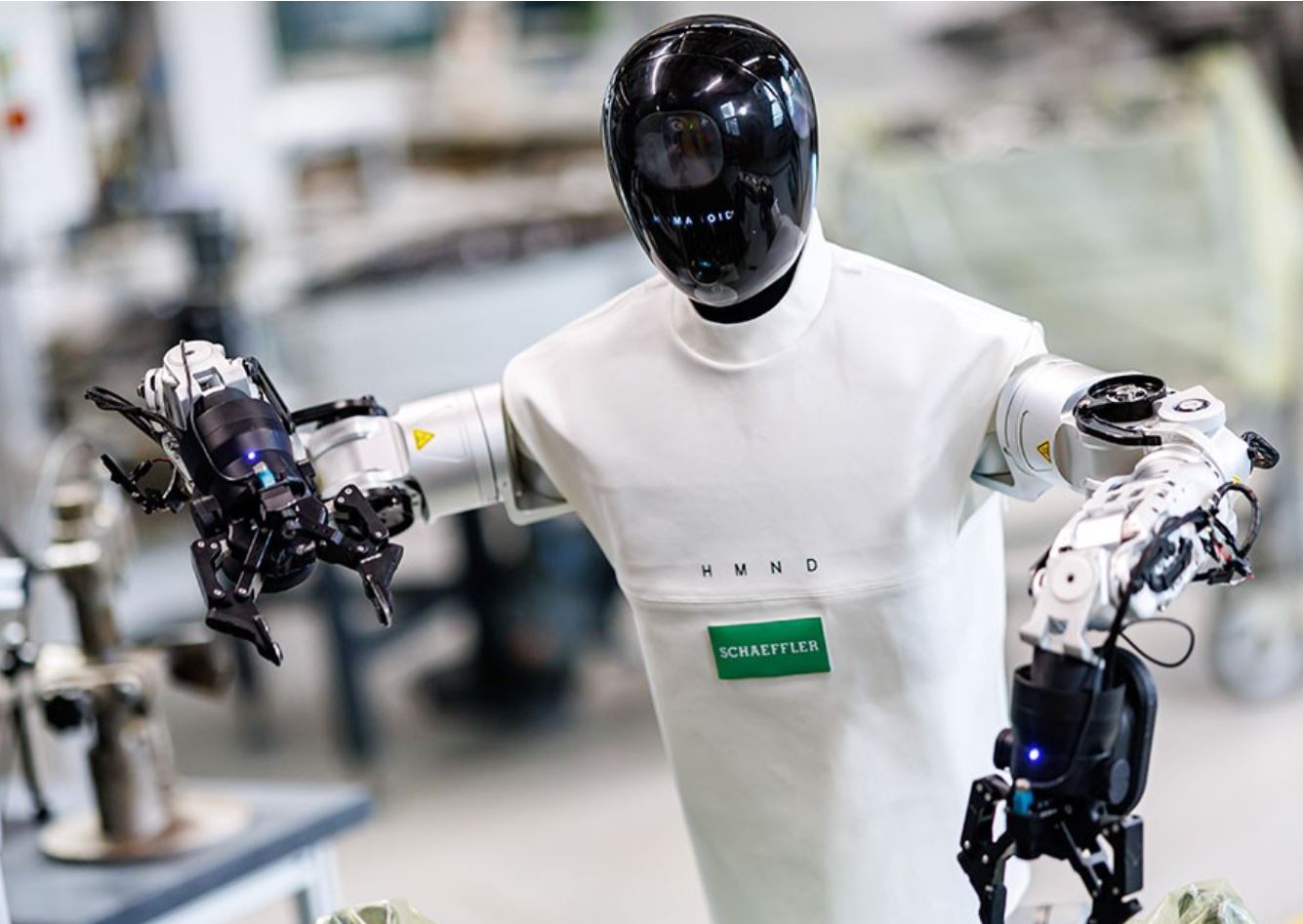
Schaeffler doesn’t just sell actuators — it buys finished humanoids and puts them on its own factory floors. By 2035 it plans to deploy several thousand humanoids across its global production network. And this is where a closed loop emerges — the real moat around the business:
- robots work on Schaeffler’s actual shop floor;
- the floor generates data (load profiles, wear, failures) that flows back into R&D;
- that data is used to refine the actuators and components;
- the improved components go both into its own robots and on sale to the robot makers themselves (OEMs).
Neither a pure component supplier nor a pure robot maker can pull this loop off alone. A supplier has nowhere to gather operational data at scale; a robot startup has nothing to extract from it at the level of actuator design. Schaeffler sits at both ends of the chain. The same logic extends to training in a digital twin on NVIDIA’s Omniverse platform — skills are honed in simulation and transferred to physical robots, while shop-floor data continuously retrains the models.
In other words, the company turns its own factories into a proving ground — the very logic I’ve covered before in pieces on Shanghai’s humanoid “school” and on 1X’s World Model Lab. Except Schaeffler builds that proving ground not as a neutral venue, but at its own expense, inside its own economics.
A partner portfolio as a geopolitical hedge
Here’s the most intriguing part for anyone following the “West vs. China in the race for robot data” storyline. Schaeffler didn’t bet on a single player — it assembled a portfolio that carefully covers both sides:
- Neura Robotics (Germany), November 2025 — joint development of compact, high-torque actuators for shoulders, elbows, and wrists; a plan to integrate several thousand Neura robots by 2035, and to use factory data to train their Neuraverse platform.
- Humanoid (UK, founded 2024), January → May 2026 — a strategic partnership that grew into a binding agreement: a four-digit number of wheeled robots on Schaeffler’s factory floors by 2032, with first deployments in Germany by late 2026. Plus a five-year actuator supply contract through 2031, under which Schaeffler covers more than half of Humanoid’s joint-actuator demand — a seven-digit number of actuators (millions of units — each robot uses dozens).
- Leju Robotics (China, Suzhou), March 2026 — its first Chinese partner. A week before the deal, Schaeffler set up a separate subsidiary, Schaeffler Humanoids, in Taicang and opened an “innovation factory,” partly as a data-collection hub. The focus is industrial use cases: equipment inspection, logistics, operations support.
What emerges is a figure standing above the West–China clash rather than on either side of it. The company supplies the “muscles” (actuators) and plugs into the “nervous system” (data and sensors, plus partnerships with NVIDIA and Microsoft) — in Europe, the US, and China simultaneously. For a Tier-1 supplier, that’s the natural strategy: you sell to every army at war, you don’t enlist in one.
Where the skepticism comes in
To keep this from reading like a press release, the other side has to be said out loud.
First, almost everything above is intentions and contracts, not revenue. “Several thousand robots by 2035,” “a seven-digit number of actuators by 2031” — these are horizons over which anything can happen. CEO Klaus Rosenfeld, defending a “conservative” 2026 outlook, pointed squarely at high one-off expenses. In other words, inside the company they soberly understand: the transformation costs money now, and the payoff comes later.
Second, the “Humanoid Premium” is a re-rating of expectations, not of results delivered. If the humanoid market moves slower than promised, the premium in the share price will deflate faster than factory pilots roll out.
Third, a component supplier’s margins are structurally lower than those of whoever owns the end product and the software. The “shovel seller” is shielded from the question of “which robot wins,” but it’s also capped on the upside: shovels aren’t an operating system.
Why this is worth keeping in mind
And yet Schaeffler’s bet strikes me as one of the most rational in the industry — precisely because it’s not about spectacle. While attention is fixed on who first teaches a robot to fold laundry, Schaeffler is quietly taking a position that wins under almost any outcome: it sells an indispensable subsystem component, it’s its own first customer, it closes the data loop onto design, and it hedges geopolitics with a portfolio of partners.
If the humanoid race is ultimately won not by the most charismatic startups but by the most boring industrial companies — the ones that can turn out a million identical actuators with predictable quality — then in hindsight the signal was visible as early as the start of 2026. And it was sent not by a robot on a stage, but by the share price of an 80-year-old bearings plant.
Sources: Schaeffler’s “Humanoid robots” page, company press releases from January–March 2026, and reporting by The Manufacturer, Humanoids Daily, Gasgoo, and Robotics & Automation News.
Cover Image & Video: Schaeffler