
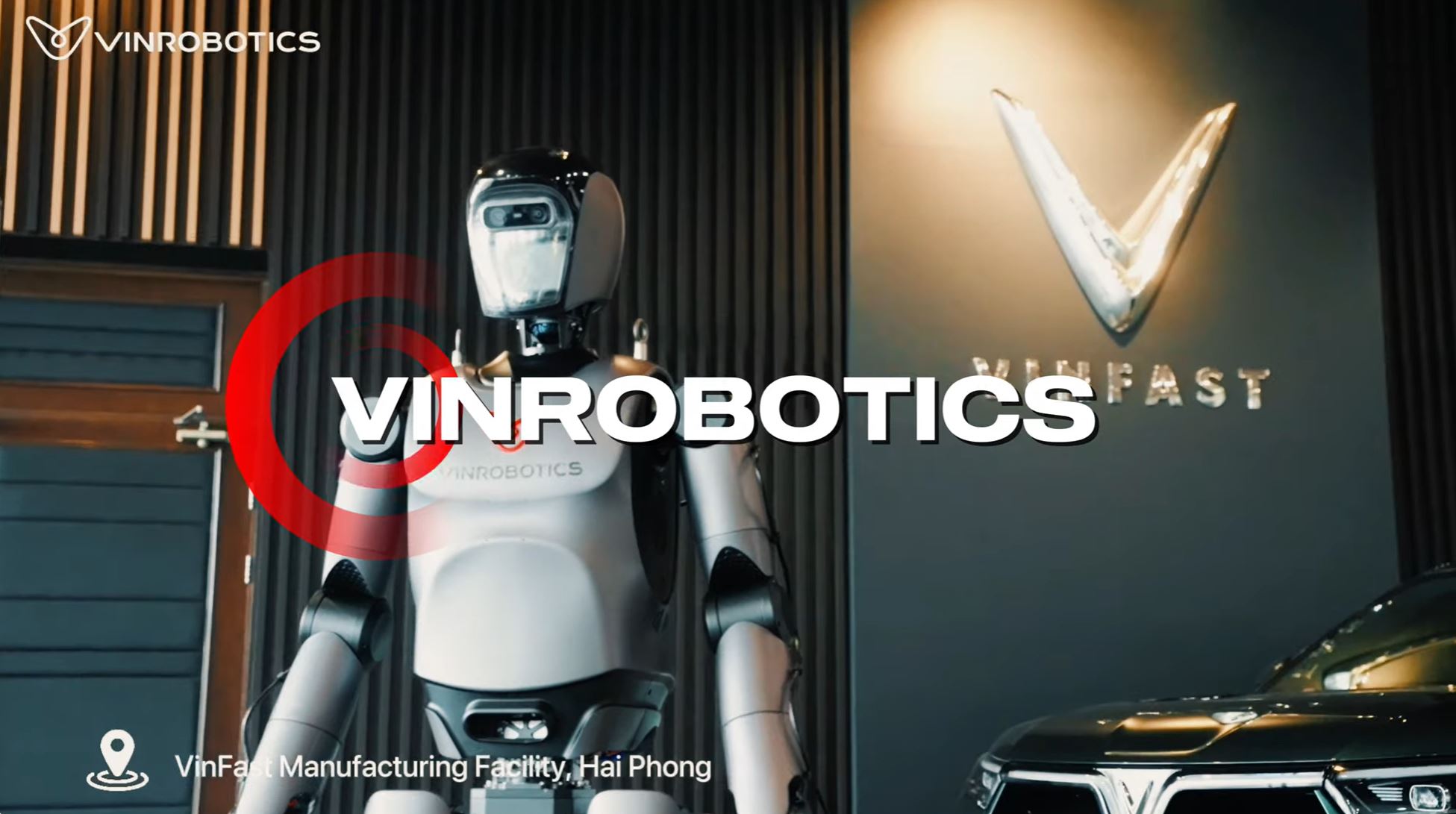
Based on Vingroup’s press release, reporting from ICRA 2026, and coverage by Interesting Engineering and TechTimes.
When people talk about the humanoid robot race, they habitually split the field in two: the US and China. Figure and Tesla against Unitree and AGIBOT. But in early June, another player muscled into that list uninvited — and it wasn’t a Silicon Valley startup. It was a Vietnamese automaker.
At ICRA 2026 in Vienna, VinRobotics showed off its humanoid, the VR-H3. VinRobotics is a subsidiary of Vingroup, Vietnam’s largest conglomerate, known abroad mainly for its VinFast electric vehicles. And it’s hard not to think of the Schaeffler story: the auto industry keeps turning out to be a natural launchpad for robotics — the same actuators, the same mechanics, the same assembly floors.
What is this robot?
The VR-H3 is already a third-generation platform. The specs sound genuinely “industrial”: more than 31 actuators, two onboard edge computers (meaning the computation runs inside the robot rather than in the cloud), the ability to lift 6–8 kg, move objects, and perform assembly tasks. At ICRA it drew attention for a striking control detail — the operator drove it via motion capture built straight into a VR headset, with no external sensors.
The main narrative VinRobotics is selling is “Make in Vietnam”: the whole foundation was developed in-house by Vietnamese engineers. The mechanical structure, the electronic architecture, the power system, the battery, the full-body AI control, even the hands and actuators — all of it in-house. It’s a pointed claim: not “assembled from Chinese components,” but “we can build it ourselves.”
Not one robot, but two
And here’s what makes this more than an ordinary debut: Vingroup showed two humanoids at ICRA in a single week, from two different subsidiaries. Alongside the industrial VR-H3 from VinRobotics, sister company VinDynamics presented a service robot called Dyno — an assistant for security and guidance, already trialed as a multilingual guide at a Vinpearl park.
One robot is an experiment. Two robots from two divisions in a week is a conglomerate’s strategy to enter the industry seriously, on two fronts at once: the factory and the service floor.
Where’s the skepticism?
Let me cool the enthusiasm before this turns into a press release. Everything shown was an exhibition demo, not work on a real production line. Control via a VR headset is teleoperation — meaning a human is still driving the robot, not an autonomous AI. The specs look solid, but no one has shown us the real speed, reliability, or autonomy on a factory floor.
“Make in Vietnam” and appearing on panels next to Google DeepMind, NVIDIA, and Boston Dynamics is also, in large part, technology diplomacy — positioning a country and a brand, not a proven product. VinRobotics is also a very young company, founded in November 2024. So the VR-H3 is a convincing bid to participate, not a finished industrial solution.
Why it matters anyway
And yet the real point here isn’t the robot itself — it’s that it exists and stepped onto the world stage. A year ago, a serious humanoid was the privilege of a handful of players from two countries. Today an automaker from Vietnam is showing one — and showing its own engineering, not bought-in hardware.
That’s the real signal: the barrier to entry is falling, and the map of players is no longer a map of two superpowers. The humanoid race will increasingly be split not into the US and China, but into those who can build robots — wherever they happen to be. And Vietnam just added its name to that list.