
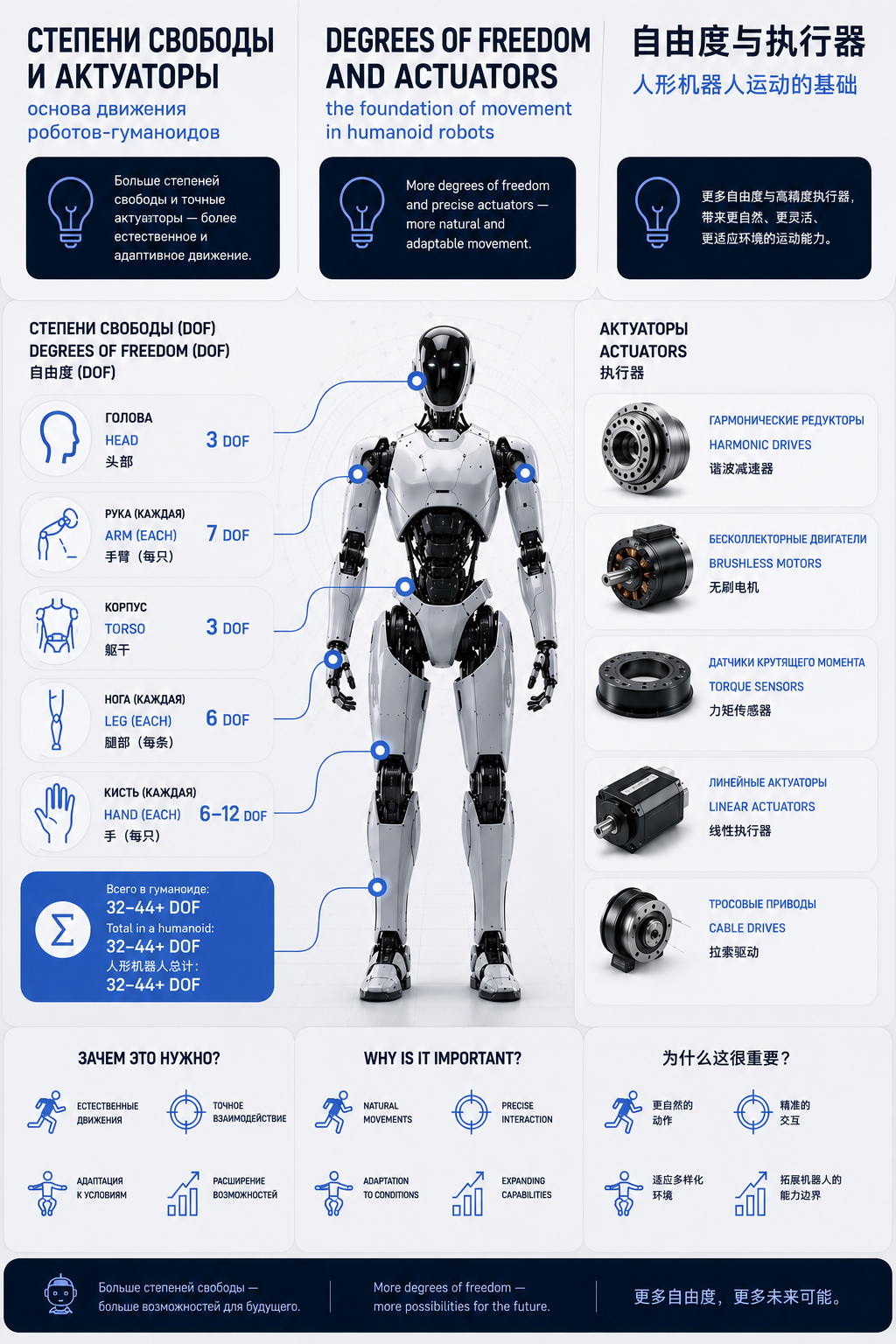
Two terms keep coming up in every humanoid robot description: “actuators” and “degrees of freedom.” Without understanding them, robotics news is just a string of numbers. Let’s break both down.
Actuators — a robot’s muscles
An actuator is a device that converts energy into physical movement. In plain terms, it’s the motor that makes a robot move.
In the human body, muscles play the role of actuators: the brain sends a signal, the muscle contracts, the arm rises. A robot works the same way: the computer sends a command, the actuator rotates the joint, the limb moves.
Actuators come in several types:
Electric — the most common. They use electric motors. Precise, relatively inexpensive, and easy to control. Found in most modern humanoids: Tesla Optimus, Unitree G1, Figure 02.
Hydraulic — powered by pressurized fluid. Extremely powerful but heavy and complex to maintain. Used in the original Atlas by Boston Dynamics. The new electric Atlas has moved away from them.
Pneumatic — powered by compressed air. Soft and safe for human contact, but less precise. Used in experimental soft robots.
Why actuators matter: they account for roughly half the cost of a humanoid robot. When we say robots have dropped 200x in price over a decade, much of that is thanks to cheaper actuators, especially from Chinese manufacturers. The quality and cost of actuators determine how strong, fast, and precise a robot can be.
Degrees of Freedom — how many moves a robot can make
A Degree of Freedom (DOF) is one independent movement a robot’s joint can perform. The more degrees of freedom, the more flexible and “human-like” the robot appears.
A simple example: a door hinge lets the door only open and close — that’s 1 degree of freedom. Your shoulder lets your arm move up-down, forward-backward, and rotate — that’s 3 degrees of freedom. Add the elbow (1 DOF), wrist (2-3 DOF), and fingers (up to 4 DOF each) — and you get a hand with 20+ degrees of freedom.
For comparison — DOF counts across different robots:
Unitree G1 — up to 43 DOF (full body)
UBTECH Walker S2 — 52 DOF
Kepler Forerunner K2 — 52 DOF (up to 11 per hand)
Boston Dynamics Atlas — 56 DOF
Fourier GR-2 — 53 DOF
A human — approximately 244 DOF (including spine, fingers, toes, jaw, eyes)
Robots are still far from human flexibility, but progress is fast: five years ago, 30 DOF was considered impressive. Today, 50+ is standard for a serious humanoid.
How these concepts connect
Each degree of freedom requires its own actuator (or several). A robot with 52 degrees of freedom has at least 52 actuators. More DOF = more actuators = higher cost = more complex control. That’s why engineers seek a balance: enough DOF to perform the task, but no more than necessary.
A warehouse robot doesn’t need 50 DOF — 15-20 will do. But a robot that needs to tie shoelaces or plug a connector into a socket needs dozens of degrees of freedom in the hands alone.
The simple takeaway
Actuators = a robot’s muscles. They determine strength and speed. Degrees of Freedom = a robot’s joints. They determine flexibility and range of motion.
Now, when you see “52 DOF” or “high-torque actuators” in a robot’s spec sheet — you know what it means.